Field note 004 · October 21, 2026
The turkey roasting pan fit plan
A turkey-weight chart cannot see your oven, rack, handles, landing zone or sink. Measure the whole roasting system before choosing the pan.
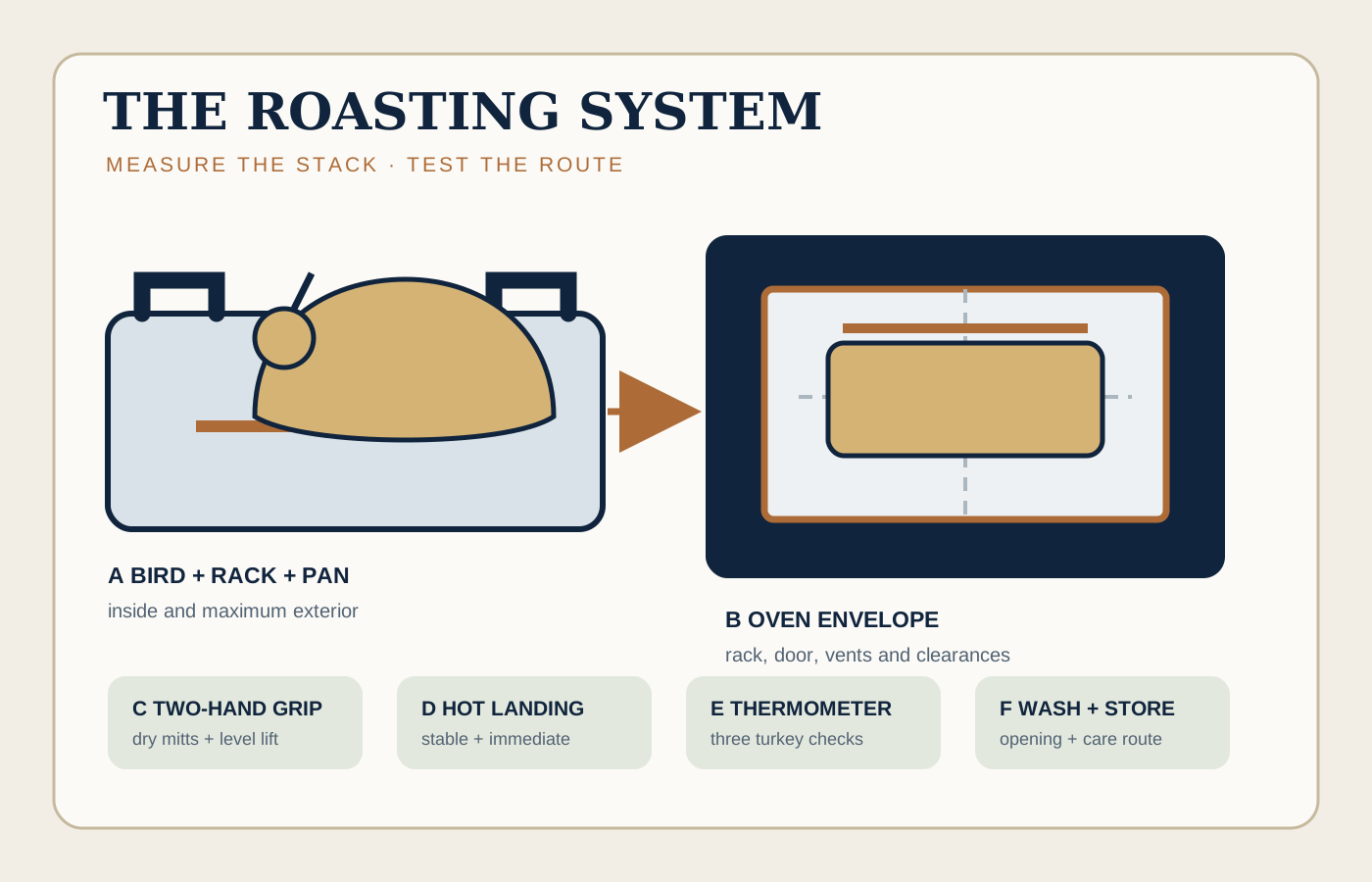
Searches for “what size roasting pan for a turkey?” usually expect one number. The real buying question has several dimensions: Will the bird sit on the rack without pressing into the sides? Will the loaded pan clear the oven door, walls, elements and required airflow? Can two protected hands lift it onto a stable landing? Can the pan be washed, dried and stored after the meal?
Current public cooking discussions show how often a nominal pan length hides projecting handles, a rack lifts the breast too close to the top heat source, or a pan fits the cavity but cannot be turned through the door. A useful plan replaces those surprises with a cardboard rehearsal and a written fit record.
This guide helps plan equipment fit. Follow the current directions for the exact turkey product, recipe, roasting pan, rack and oven. Do not bend handles, defeat rack stops, block vents, let cookware contact a heating element or operate with the oven door ajar to force a fit.
Measure in the order the parts stack
1. Start with the actual bird
Turkey weight is useful for food planning, thawing and approximate cooking time, but it does not define one exterior shape. Birds of similar weight can differ in breast height, body length and width. Packaging, neck position and leg trussing also change the space used before and during preparation.
If the turkey is frozen, record the labeled weight and package dimensions for early planning. Make the final fit decision only when the bird is safely thawed enough to measure and the package directions are readable. USDA FSIS says refrigerator thawing takes about 24 hours for every four to five pounds at 40°F or below. Keep the turkey in a container that catches leaks and separates raw juices from ready-to-eat food.
Measure the prepared bird at its widest point, longest point and highest point in the orientation required by the chosen recipe. Do not assume that a spatchcocked bird uses less pan area; flattening reduces height while expanding width. Do not change the preparation method merely to rescue a pan purchase unless you have a complete recipe for that method.
2. Add the roasting rack
Measure the rack's support surface, feet, handles and highest point. Set it inside the candidate pan and confirm that every foot is supported without rocking. Then place a wrapped substitute or cardboard bird template on the rack during the cold rehearsal. The rack can lift a turkey several inches, so total height matters as much as pan length.
USDA FSIS describes placing a whole turkey breast-side up on a flat wire rack in a shallow roasting pan about 2 to 2½ inches deep for its conventional oven-roasting method. That guidance belongs with the rest of the USDA method. A deeper or covered vessel, roasting bag, convection setting or alternative preparation may have different directions.
3. Measure the pan twice
Interior length and width tell you whether the food and rack can sit inside. Maximum exterior length and width tell you whether the pan fits the oven. Record both. Include fixed or folding handles, rolled rims, spouts and any lid hardware. If handles swing out under load, measure the operating position as well as the storage position.
Record pan depth, base dimensions and empty weight. Add the bird's labeled weight and a conservative allowance for rack, liquid, vegetables or other recipe ingredients to understand the handling load. Do not use this arithmetic as a manufacturer load rating. If the maker does not publish a capacity or handling limit, leave the limit unresolved.
4. Measure the usable oven envelope
Measure the flat supported area of the oven rack in the position required by the manual and recipe. Capture width between rails, usable front-to-back depth, door sweep and clearance to walls, vents and heating elements. The widest empty cavity dimension is not the usable rack dimension.
Measure vertical clearance from the supporting rack to the nearest obstruction above, then compare it with the assembled pan, roasting rack and bird height. Check the exact oven manual for rack position, cookware clearance, convection guidance and restrictions. Similar exterior appliance widths can contain different rack geometry.
Close the cold oven door gently during a cardboard test. If the handle touches the glass, door, wall or gasket, the setup does not fit. Never rely on forcing the door or rotating a hot, loaded pan diagonally inside the oven.
Build a roasting-pan fit record
Write the measurements before comparing products. A product title such as “large roaster,” “18-inch pan” or “fits a 20-pound turkey” is not enough. The number may describe a nominal rim length while the handles extend farther, and the weight claim may rely on a bird shape different from yours.
| Part | Measurement or instruction | Pass condition |
|---|---|---|
| Prepared turkey | Maximum L × W × H; labeled weight | Sits fully on the intended rack without pressing into the pan |
| Roasting rack | Footprint, feet, lift and handles | Stable, maker-approved and supported by the pan |
| Pan interior | Usable base and rim L × W; depth | Contains the rack and recipe ingredients as directed |
| Pan exterior | Maximum L × W × H including handles | Clears oven, door and maker-required air path |
| Oven | Usable rack area, position, vertical clearance | Matches the exact appliance manual |
| Handling | Loaded estimate, grip width, two-mitt space | Can be lifted level without touching the cavity |
| Landing | Heat-safe surface L × W and route | Immediate, stable destination with no traffic conflict |
| Cleaning | Sink opening, faucet path, maker care | Can be washed and dried as instructed |
| Storage | Cabinet opening, shelf and reach | Pan enters without tipping an unstable stack |
Save the oven model number, manual URL, pan and rack specification sources, measurement date and return terms. Specifications can change between revisions. Photographs help document handle shape and rack position, but they do not replace dimensions.
Why a weight-to-pan chart is only a screening tool
A chart can narrow a search, but it cannot guarantee fit. A wide bird may crowd a pan marketed for its weight. A narrow bird may fit while the pan handles fail the oven. High rack feet may create a vertical problem that a top-down chart misses. Use any seller's fit claim as one input to verify against published dimensions and your cold rehearsal.
Reject listings that provide only a nominal size, staged photograph or unsupported “universal fit” language. A review can describe one person's oven and turkey, but it does not verify yours. Future product listings on this site would need maximum exterior dimensions, usable interior dimensions and documented accessory fit before making compatibility claims.
Plan the safe roasting workflow
Stage the raw-turkey route
Clear a short route from refrigerator to preparation area to oven. Keep raw turkey and its juices away from side dishes, produce, serving ware and the refrigerator handles other cooks need. USDA advises against washing raw turkey because splashing can spread bacteria around the sink and kitchen. Follow the package and recipe for preparation.
Move the oven rack before preheating. Remove stored cookware and confirm the oven is empty. Prepare a stable, heat-safe landing surface large enough for the pan and handles. Keep paper, towels, packaging and other things that can burn away from the cooking area.
Separate time estimates from doneness
USDA's roasting tables are approximate. For a conventional whole-turkey method, USDA says to set the oven no lower than 325°F and use a food thermometer. A whole turkey reaches the safe minimum when it measures 165°F in the innermost thigh, innermost wing and thickest breast, avoiding bone. Stuffing, if used, must also reach 165°F; USDA recommends cooking stuffing separately for optimum safety.
A pop-up indicator or clock does not replace checks in those locations. Choose a thermometer that can reach the measurement points without forcing your protected hand against the hot pan or oven. Rehearse the probe angle while everything is cold.
Protect the hot handoff
A loaded roasting pan can be awkward even when its ingredients are within a user's normal lifting range. Wide handles may leave little room for thick mitts between the pan and oven wall. Short handles may be hard to capture without leaning over the door. Test both-hand placement with dry mitts during the cold rehearsal.
Open the path before the pan moves. Keep children, pets, chairs and guests out of it. Lift level, move directly to the prepared landing and set the entire base down. Do not carry the hot pan to a sink, balance it across burners or improvise a landing after the oven is open.
The U.S. Fire Administration says Thanksgiving is the peak day for home cooking fires. Stay nearby while roasting, use a timer and check the food regularly. In an oven fire, turn the oven off and keep the door closed until it is cool, following official emergency guidance.
Plan carving and leftovers before serving
USDA advises letting a cooked turkey stand for 20 minutes before carving. The landing area must therefore remain available while other dishes move through the kitchen. Decide whether the bird will rest in the roasting pan or transfer according to the recipe and equipment instructions, and make sure the destination can contain juices.
Refrigerate turkey and stuffing within two hours. Divide leftovers into smaller pieces and shallow containers so they cool promptly; USDA guidance lists three to four days for refrigerated leftovers. Give containers a clear shelf before the meal rather than trying to create refrigerator space afterward.
The purchase rule
Buy the smallest complete system that passes
The useful unit is pan + rack + bird + oven + two-hand grip + landing + cleaning + storage. More capacity is not automatically better. Oversizing can create poor access, excess weight and an appliance-clearance failure.
Run a cold rehearsal before the return window closes
- Find the exact manuals. Save the oven, roasting pan and rack instructions and record model numbers.
- Measure the bird plan. Record labeled weight, intended preparation and estimated dimensions; repeat after safe thawing.
- Cut a full exterior template. Include handles and mark the interior base, rack and prepared-bird outline.
- Stack the height. Build a cardboard side profile for pan, rack and bird, then compare it with the planned oven position.
- Test the cold oven. Confirm rack support, door closure, manual clearances, grip space and a straight removal path.
- Carry a safe substitute. Add sealed pantry weight only within a comfortable range and rehearse the two-mitt move with a helper nearby.
- Land, wash and store. Check the complete route through the heat-safe landing, carving area, sink, drying place and cabinet opening.
- Save the record. Keep dimensions, photos, source links and unresolved questions together.
A listing standard for roasting equipment
Ultimate Kitchen Supply is a planning preview. Prices, checkout, inventory, branded listings and availability remain disabled until supplier authorization and accurate commercial terms are documented. The new Holiday Roasting System brief in the preview catalog defines the evidence a future listing would need without implying that an item is available.
A publishable roasting-pan listing should state maximum exterior and usable interior dimensions, base geometry, depth, empty weight, maker load or capacity statement where one exists, handle positions, included rack dimensions and lift, material, finish, temperature limit, stovetop compatibility, dishwasher guidance, cleaning restrictions, warranty source and replacement-rack path. Turkey-weight claims should identify their source and make clear that the buyer must verify the actual bird and oven.
Frequently asked questions
What size roasting pan do I need for a turkey?
No single dimension works from weight alone. Measure the prepared bird, rack and maximum pan exterior, then compare the assembled footprint and height with the exact oven manual and a cold fit test.
How deep should the pan be?
USDA's conventional method describes a shallow roasting pan about 2 to 2½ inches deep. Use that depth with the rest of the method, then verify the pan and rack instructions. A deeper pan is not automatically safer or more capable.
Can the roasting pan touch the oven wall?
Use the clearances in the exact appliance manual. Contact with the door, wall, element, rack guide or vent is a failed fit. Do not operate with the door ajar or alter handles to force the pan inside.
Is a pop-up timer enough?
USDA advises using a food thermometer. Check a whole turkey at the innermost thigh, innermost wing and thickest breast; each must reach 165°F without the probe touching bone. Check stuffing separately at its center if the bird is stuffed.
Sources
Reviewed October 21, 2026. The turkey package, recipe, cookware instructions and exact oven manual govern the setup.