Field note 003 · October 14, 2026
The food-allergy-aware pantry plan
A pantry cannot diagnose an allergy or guarantee safety. It can make the household plan visible: what gets checked, where food goes, which tools are shared, how surfaces reset and when everyone stops to ask.
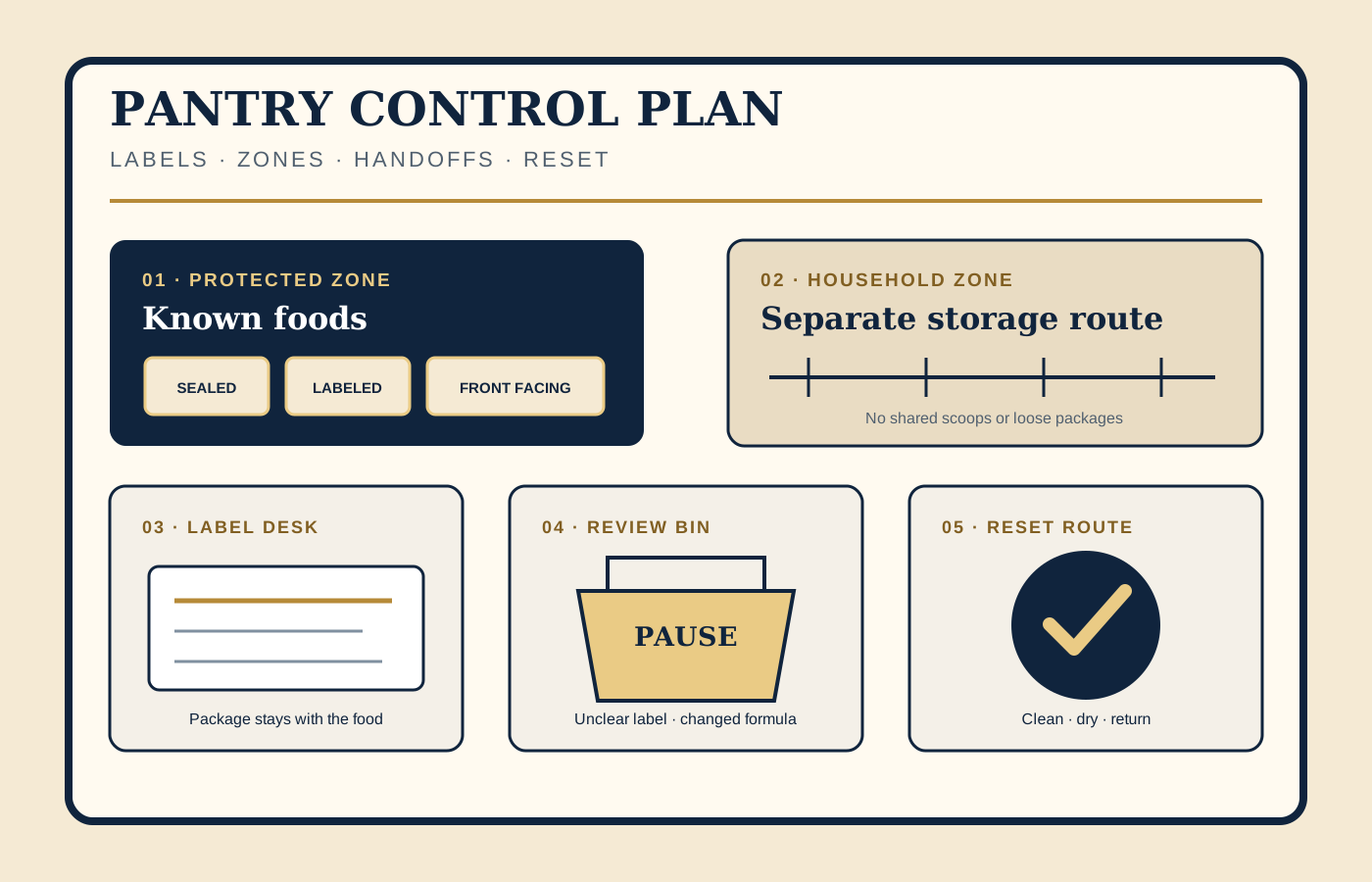
A row of matching containers can look controlled while hiding the information that matters most. A practical food-allergy-aware pantry keeps the current package label connected to the food, separates unresolved items from approved ones, gives each household member a clear return path and extends the plan from the shelf to preparation and cleanup.
That distinction matters during the holiday cooking season, when familiar products arrive in new sizes, guests bring ingredients, several recipes share a counter and food moves quickly between pantry, refrigerator, oven and table. Public pantry discussions repeatedly raise the same useful questions: Should flour sit above other food? Can packages be decanted? How should shared scoops be handled? What happens when someone puts an item back in the wrong bin? The answer is a system that is easy to follow on an ordinary busy day.
This guide is for kitchen organization. It does not determine which foods are safe, how much exposure is safe or what to do during a reaction. Use the avoidance and emergency plan provided by the person’s qualified health professional. If a label, ingredient or preparation method is uncertain, pause rather than infer.
Define the household baseline
Begin with the exact foods and forms the household needs to avoid. Federal labeling rules focus on nine major food allergens—milk, egg, fish, Crustacean shellfish, tree nuts, peanuts, wheat, soybeans and sesame—but the FDA notes that many other foods can cause allergic reactions. A pantry layout should therefore reflect the individual plan, not only the federal list.
Write one short household standard in plain language. Identify who reviews labels, which foods require a protected route, whether any ingredients or products are excluded from the home, how uncertain items are handled, which tools or appliances need special controls and where the emergency plan is kept. Make the standard usable for family, guests, caregivers and anyone who helps unpack groceries.
Do not let a color system carry the full meaning. Red and green may be hard to distinguish, stickers fall off and a guest may not know the code. Pair color with readable words and a consistent location. A bin marked “review before use” is clearer than an unlabeled red box.
Make the package label part of the storage system
Read the ingredient list and allergen declaration
FDA-regulated packaged foods that contain a major food allergen must identify its food source. That may appear in the ingredient list, in parentheses after an ingredient or in a “Contains” statement beside the ingredient list. When a Contains statement is present, it must name all major food allergens used as ingredients. The type of tree nut and the species of fish or Crustacean shellfish also matter under the labeling rules.
Do not read only the front claim. “Plant based,” “nondairy,” “natural” and other marketing language do not replace the ingredient list and allergen declaration. Read the complete current package each time, including on a product the household has bought before. The FDA’s sesame guidance specifically warns that familiar products may change formulations.
Treat advisory statements as unresolved risk information
Statements such as “may contain” or “produced in a facility with” are voluntary precautionary allergen labeling. The FDA explains that there is no uniform rule governing what those phrases mean and that one wording does not reliably indicate a higher or lower chance of cross-contact. Do not create a household ranking in which “made in a facility” is automatically considered safer than “may contain.” Apply the person’s health-care plan consistently.
Keep the current label with decanted food
Decanting can improve access and reduce torn bags, but it can also sever the food from its ingredient list, allergen statement, lot code, best-by date and preparation directions. If the household uses canisters, transfer only after the label has been reviewed. Attach the original panel or retain the complete package in the same bin. Record the product name and lot code in a way that cannot be confused with the next refill.
Do not top up an old container with a new package while product remains. The formula, facility statement or lot may differ, and the older crumbs can blur which label applies. Empty the container, follow the household cleaning procedure, dry it fully and then refill from one reviewed package.
Create one review bin
Any unlabeled, changed, guest-provided or unclear item goes into a closed “review before use” bin outside the protected zone. This is a pause point, not long-term storage. Set a weekly time for the responsible adult to resolve items by checking the current label, contacting the manufacturer when appropriate or removing the product from the kitchen. Never ask a child or guest to make a technical label judgment under pressure.
| Record | Why it matters | Where it stays |
|---|---|---|
| Complete ingredient and allergen panel | Shows the current formulation and declared sources | On the package or attached to its container |
| Brand, exact product and size | Separates similar-looking varieties | Front-facing label |
| Lot code and date information | Supports recall and freshness checks | Original panel or storage record |
| Date opened or decanted | Supports rotation and review | Removable written label |
| Household status | Shows reviewed, general household or unresolved | Words plus a consistent zone |
Map zones around movement, not appearance
Place protected food where spills cannot fall into it
A protected zone should be easy for the intended user to reach and easy for everyone else to recognize. Store open bags, flour-like powders, nut pieces and other spill-prone household ingredients where they cannot shed into protected food below. Use closed, cleanable bins to contain packages; the bin does not make an unsafe package safe, but it can define the return address and limit a spill.
Choose shelf height by real users. Food for a child should not require climbing. Heavy jars belong where an adult can lift them without passing over protected packages. Frequently used reviewed foods should be visible from the front so they are not displaced by less-used stock.
Separate tools by function and cleaning need
Shared scoops invite a direct path from one ingredient to another. Keep a scoop inside a single labeled container only when that method fits the household plan and can remain clean and dry. Otherwise, use a clean utensil for each task and move it immediately to the wash route. Do not return a used measure to a dry ingredient container.
Some households use dedicated boards, strainers, toasters or other tools because crevices, porous surfaces or complex interiors are difficult to clean predictably. Decide this with the individual medical plan and the tool’s manufacturer instructions. Give dedicated equipment a labeled storage position so “separate” does not quietly become “shared when the kitchen is busy.” For an appliance station, also measure operating clearances and the cleanup path with the countertop appliance fit plan.
Extend the map beyond the pantry
The storage plan should connect to a refrigerator shelf, freezer bin, counter staging area, cooking zone, serving area and dishwashing route. A protected pantry bin alone does little if opened ingredients share an unlabeled refrigerator container or if serving spoons cross between dishes.
Write the handoff as a short path: reviewed storage → clean staging area → prepared with planned tools → clearly identified serving position → leftovers labeled before refrigeration → tools and surfaces reset. If the path crosses a crowded baking area, use the bakeware fit matrix to reserve a landing and cooling zone before cooking starts.
Plan preparation and cleanup as one sequence
Stage the protected task first
When the household plan permits both protected and other foods in the same kitchen, scheduling can reduce confusion. Begin with clean hands, clean tools and a cleared work area. Gather every reviewed ingredient before opening packages. Finish and cover the protected preparation before other ingredients enter the station. This sequence does not replace the person’s cross-contact controls; it makes the controls easier to observe.
Use full cleaning rather than a cosmetic wipe
Cross-contact is the unintentional incorporation of an allergen into another food. In an FDA study of retail food-contact surfaces, the effectiveness of allergen removal depended on the food, amount, surface and wiping method. A full wash-rinse-sanitize-air-dry procedure was effective in the study, while a quick dry wipe was not an equivalent control. The study was conducted in retail settings, so a household should apply the cleaning agents, concentrations and methods appropriate to its surfaces and equipment, following product and manufacturer instructions.
Build enough space for the complete reset. Scrape or remove visible food, wash as directed, rinse when required, apply any sanitizer according to its label, and allow the surface or item to dry as directed. Keep used cloths from traveling back across a clean area. A clean-looking surface is not evidence that a particular allergen has been removed.
Control hands, handles and small touch points
Ingredient residue can move on hands, jar rims, faucet handles, appliance controls, drawer pulls, phones and towels. Plan the task so the cook can wash hands at the right moments without carrying an open package across the room. Set out clean towels before work begins, and keep the recipe display away from food and the sink. FDA consumer research on kitchen device use reinforces the practical value of minimizing contact and washing hands regularly during cooking.
Label the finished food before attention shifts
Use a clear name rather than a vague mark. Identify the dish, date, relevant household status and any serving-tool instruction. Cover it before other food arrives. If several dishes look similar, assign distinct serving positions and utensils. Do not rely on memory after guests enter the kitchen or containers move to the refrigerator.
Holiday handoff
Give every incoming dish a gate
Set one surface for guest food and one person to receive it. Ask for the original package or complete ingredient information, but do not promise safety based only on a spoken list. If the household plan cannot resolve the food’s ingredients or preparation conditions, keep it outside the protected route.
Check recalls as an inventory task
Undeclared allergens are a recurring reason for food recalls. Keep brand, product, size and lot information so a notice can be matched to the pantry. Review the FDA recall page on a routine schedule and whenever a product notice reaches the household. A decorative canister without a lot code makes that check harder.
Run a thirty-minute pantry audit
- Write the baseline. Use the individual medical plan to list the exact foods, forms and household controls that apply.
- Empty one working shelf. Start small enough to finish. Clean and dry it according to the surface and product instructions.
- Review every package. Read the current ingredient list and allergen information. Move unclear items to the review bin.
- Choose protected locations. Account for spills, reach, weight, visibility and the path to the preparation area.
- Assign tools. Decide which are shared, separately stored or not suitable for the planned use, following the household plan and maker instructions.
- Rehearse a recipe cold. Move closed packages and clean tools through staging, preparation, serving, leftover storage and cleanup.
- Test another user. Ask a caregiver or family member to return five items and explain what happens with an unclear label.
- Save the record. Photograph zones, write the reset sequence and schedule label, recall and inventory reviews.
What to buy only after the plan works
A functional setup may need a small number of closed, washable bins; readable labels; a review container; and storage that keeps packages upright. Measure shelf width, depth, height, door opening, hinges and reach before choosing organizers. Leave finger clearance and enough open space to read labels without unloading the shelf.
Clear containers can improve visibility, but transparency is not a substitute for words, and more bins can add extra handling. Select the fewest pieces that make the return path obvious. Favor smooth, cleanable surfaces and replaceable labels. Record material and cleaning instructions before purchase.
Ultimate Kitchen Supply remains a planning preview. Prices, checkout, inventory, branded listings and availability are disabled until supplier authorization and accurate commercial terms are documented. Any future pantry organizer listing should state internal and external dimensions, opening geometry, materials, cleaning limits, lid or gasket replacement path, stack limits and label compatibility. It should never imply that an organizer prevents allergic reactions or makes food safe.
Frequently asked questions
Should packaged food be decanted into matching containers?
Only when the original ingredient and allergen information stays attached or immediately available. A uniform container is not useful if the household loses the current label, lot code, date information or preparation directions.
Does a separate pantry bin make food safe?
No. A bin is an organization control, not a safety guarantee. The household still needs a personalized avoidance plan, current label review, cross-contact controls, suitable cleaning and clear preparation practices.
What should happen when a familiar label changes?
Pause before shelving or serving it. Compare the complete current ingredient list and allergen information, follow the household’s medical plan and contact the manufacturer when the label does not resolve the question.
Sources
Reviewed October 14, 2026. The person’s health-care plan and current product labels govern individual decisions.
- U.S. Food and Drug Administration — Food Allergies
- U.S. Food and Drug Administration — Have Food Allergies? Read the Label
- U.S. Food and Drug Administration — The FASTER Act: Sesame Is the Ninth Major Food Allergen
- U.S. Food and Drug Administration — The Current Food Allergen Landscape
- U.S. Food and Drug Administration — Allergen Removal and Transfer Using Wiping and Cleaning Methods
- U.S. Food and Drug Administration — Recalls, Market Withdrawals & Safety Alerts
- U.S. Food and Drug Administration — Smartphone or Tablet Use in the Kitchen