Field note 006 · November 5, 2026
The holiday refrigerator space plan
A refrigerator can hold the groceries and still fail the meal plan. Measure the turkey tray, shelf openings, cold-air route and leftover containers before the holiday week begins.
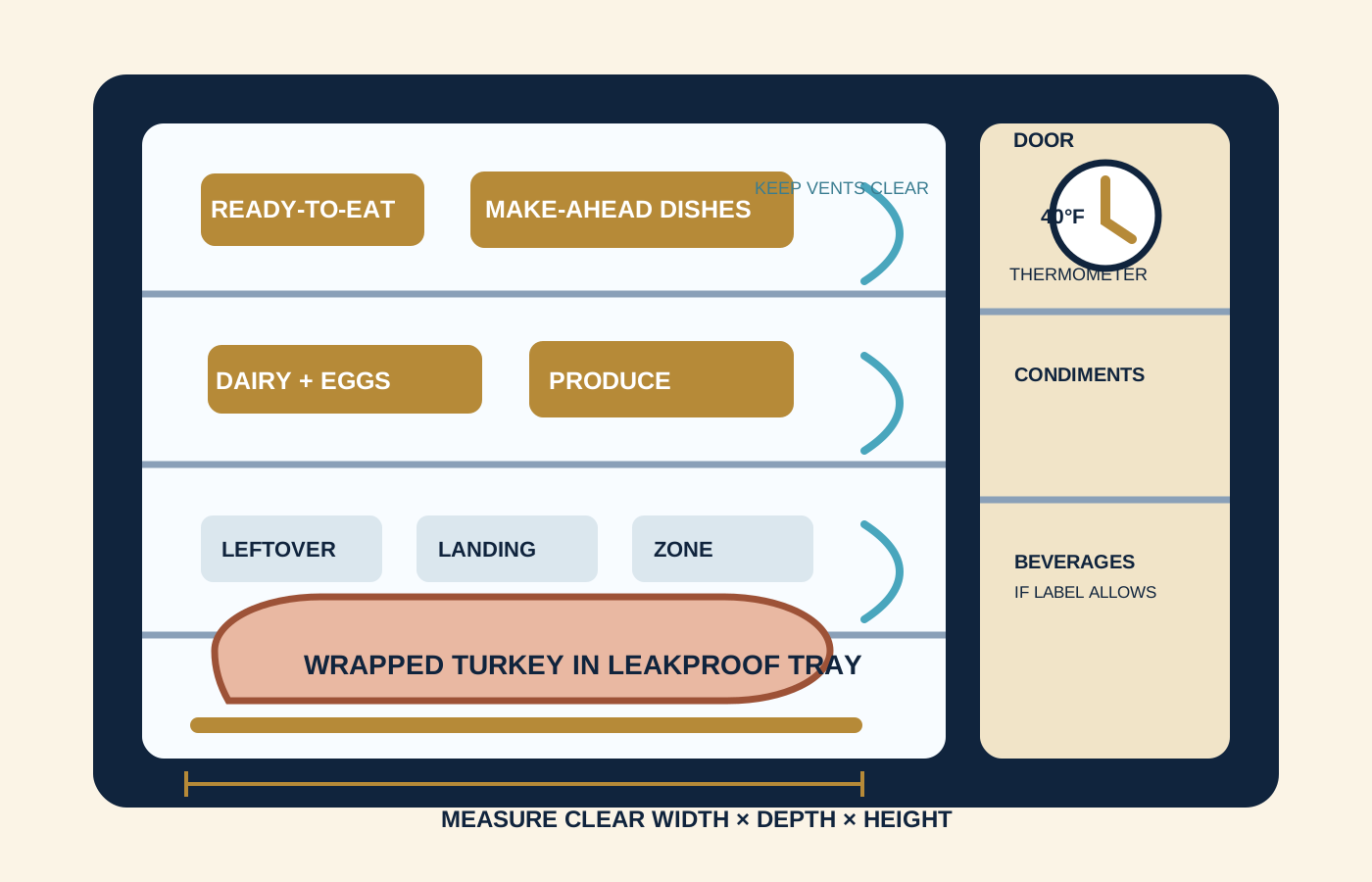
Holiday refrigerator planning is a timing problem disguised as a storage problem. The largest item may occupy the safest shelf for several days, make-ahead dishes arrive in waves, and the meal ends with hot food that needs shallow containers and prompt refrigeration. A shelf map made before shopping protects all three stages.
Public holiday-food discussions return to the same practical questions: Will the wrapped bird and its drip tray fit with the door closed? Can a tall shelf be moved without blocking a vent? Where will chilled desserts wait? Which containers will receive leftovers while the table is still being cleared? This plan turns those questions into measurements. Food-safety decisions come from FDA, USDA FSIS and CDC guidance, plus the refrigerator's own manual—not from a staged refrigerator photograph.
Keep the refrigerator at 40°F or below and the freezer at 0°F or below. Use appliance thermometers, keep cold-air vents clear and follow the exact refrigerator manual. A crowded cabinet, a cold-looking package or a winter garage is not a temperature measurement.
Measure the refrigerator in six layers
1. Record the clear shelf opening
Measure each usable shelf at its narrowest clear width and depth. Then measure vertical clearance from the shelf surface to the shelf, drawer, light housing or duct above. Repeat with the door fully closed: bins and guards can project into the cabinet, so an item that enters the opening may still prevent the gasket from sealing.
Record adjustable shelf positions and the direction each shelf must move for removal. Do not cover a cold-air outlet, return vent, sensor or light. The appliance manual controls vent clearance, shelf loads and permitted shelf arrangements. A generic “leave two inches” rule is not a substitute for the model-specific instructions.
2. Measure the turkey package and containment tray
Use the package's maximum width, depth and height rather than its labeled weight. Add the full exterior dimensions of a rimmed, leakproof container that can hold the wrapped turkey without bending or overhanging. Measure at the tray handles and lip. Test the empty combination on the chosen shelf and close the door gently.
CDC advises keeping the turkey in its original wrapping and placing it in a container before refrigerator thawing. USDA advises putting raw meat, poultry and seafood in containers so juices cannot drip onto other foods. Give this containment job priority over a decorative shelf arrangement. If the package leaks, clean the spill promptly and keep it away from ready-to-eat foods.
3. Verify the cold-air route
FDA advises against overpacking because cold air must circulate around refrigerated foods. There is no universal fill percentage that proves a refrigerator is safe. Mark the model's supply and return vents on the shelf map, leave the manual's required clearances, and avoid building a wall of containers from the back panel to the door.
Place an appliance thermometer where the manufacturer recommends, allow the cabinet to stabilize, and read it without holding the door open. Check before the turkey arrives and again after the holiday load is staged. If the refrigerator cannot maintain 40°F or below, rearrange or reduce the load and follow the appliance troubleshooting guidance; do not simply turn the control to an extreme setting and assume every shelf is safe.
4. Inventory the containers, not only the menu
List every refrigerated dish by its actual container footprint and height: stock pot, casserole, mixing bowl, dessert carrier, brining vessel, cartons and covered trays. A recipe name does not reveal whether its container nests, stacks safely or clears a shelf. Mark the date and time the dish enters and leaves the refrigerator.
Transfer foods to smaller covered containers when the recipe and food-safety guidance allow it. Do not rely on unstable stacking, foil that cannot support weight or a serving platter balanced across shelf rails. If guests are bringing food, ask for container dimensions and arrival time along with the dish name.
5. Reserve a leftover landing zone
Before cooking, set aside enough clear shelf area for several shallow, covered containers. FDA recommends dividing large amounts of leftovers into shallow containers for quicker cooling. The landing zone should not require moving the raw turkey or removing shelves while hot food is waiting.
Stage clean containers, lids, labels and a marker together outside the refrigerator. Match lids before the meal. Wide, shallow containers usually create a faster and more predictable packing sequence than one deep stock pot, but the useful shape depends on your shelf dimensions and the portions being chilled.
6. Measure the freezer buffer
Inventory the freezer before the holiday week. Use its actual shelf and drawer dimensions, preserve airflow and maintain 0°F or below. Decide which foods are moving to the freezer and when; “freeze the rest” is not a plan unless suitable containers and a labeled landing area are ready.
Do not move perishables to a porch, garage, car or outdoor box based on the weather forecast. Outdoor temperatures change, sunlight warms surfaces, animals and contamination are uncontrolled, and a freezing cycle can damage food quality. Use a refrigerator, freezer or properly managed cooler with enough ice or cold packs and verify temperature.
Build the thaw calendar backward
Start with the cooking day and the turkey's labeled weight. USDA says refrigerator thawing takes about 24 hours for every 5 pounds. Round up to whole 24-hour blocks and add the permitted 1-to-2-day refrigerated hold after thawing only when it helps the cooking schedule. Never thaw a turkey on the counter.
| Labeled weight | Allow about | Space implication |
|---|---|---|
| Up to 5 lb | 1 full day | Tray and shelf must be ready at least one day before cooking |
| More than 5 to 10 lb | 2 full days | The turkey owns its safe zone across two meal-prep cycles |
| More than 10 to 15 lb | 3 full days | Plan make-ahead containers around a multi-day thaw |
| More than 15 to 20 lb | 4 full days | Clear the shelf before the busiest shopping period |
| More than 20 to 25 lb | 5 full days | Measure early; a large package can alter the whole shelf map |
This table is a scheduling aid, not a readiness test. Follow the package and USDA instructions. If using cold-water or microwave thawing, USDA says the turkey must be cooked immediately after thawing. Those methods change the cooking-day workflow; they do not create extra refrigerated holding time.
Use a four-column cold-space calendar
For each day, list the turkey, make-ahead dishes, incoming groceries and outgoing food. Then add a final row for leftovers. The calendar exposes collisions that a single shopping list hides: a thawing bird may still occupy the tray shelf when three casseroles arrive, or the freezer may be full when leftover portions need a longer storage plan.
- Seven days out: read the refrigerator manual, check thermometer readings, inventory food and discard only items that should no longer be kept.
- Before the thaw: measure the wrapped package, test the containment tray, clean the shelf and mark vents that must remain open.
- During the thaw: keep the bird wrapped and contained, check for leaks, verify 40°F or below and avoid repeated door opening.
- Prep days: place ready-to-eat foods away from raw poultry, label covered dishes and preserve cold-air paths around containers.
- Meal day: clear the leftover landing zone, match clean lids and keep a timer visible for prompt refrigeration.
- After the meal: portion, cover, label and refrigerate or freeze promptly; review storage times rather than relying on smell.
Map shelves by risk and workflow
FDA says ready-to-eat foods and produce should be kept in a separate area from raw meat, poultry, seafood and eggs. For the turkey, choose a contained position that prevents any drip from reaching other foods. A lower shelf is often practical, but the exact safe location must also support the tray, maintain 40°F or below and keep vents open.
Use upper or separate shelves for covered ready-to-eat foods and make-ahead dishes. Keep eggs in their carton inside the refrigerator rather than in the warmer door. Door storage is best assigned by the food label and refrigerator manual; do not move highly perishable items there merely to free a shelf.
Do not wash raw turkey. CDC warns that washing can spread germs to other food, the sink and counters. Keep raw-poultry tools and packaging from crossing the ready-to-eat route, wash hands as directed and clean and sanitize food-contact surfaces after handling.
The fit rule
Every item needs a safe place and a departure time
A shelf map passes only when the door seals, vents stay clear, the appliance holds 40°F or below, raw poultry is contained, ready-to-eat food is separated and the leftover landing remains available.
Copy this refrigerator fit worksheet
| Zone | Record | Pass condition |
|---|---|---|
| Refrigerator | Model; manual link; thermometer location; current reading | 40°F or below with the planned load |
| Chosen turkey shelf | Clear W × D × H; shelf load; vent positions | Tray fits flat, door seals and airflow stays open |
| Turkey package | Labeled weight; maximum W × D × H; arrival date | Backward thaw calendar is complete |
| Containment | Tray exterior W × D × H; rim; handles | Wrapped package is fully supported and drips are contained |
| Make-ahead food | Container size; covered; in/out date and time | Separated from raw poultry with air space around it |
| Door | Bin projection; gasket path; assigned labeled foods | No container interferes with closure |
| Leftover landing | Count and size of shallow containers; lids; labels | Clear before the meal and reachable without moving raw food |
| Freezer | 0°F reading; open footprints; container labels | Airflow and a planned frozen-storage route remain |
Do an empty-container rehearsal
Place the clean, empty turkey tray and every planned make-ahead and leftover container into the refrigerator. Use removable paper labels to show what each will hold. Close the door, confirm shelves sit correctly, check that vents and sensors remain unobstructed, and photograph the passing layout for reference.
Then remove the leftover containers and reserve their outlined footprint with a washable shelf label or a simple note on the door. That empty space is working capacity, not wasted capacity. If the complete rehearsal cannot preserve airflow and temperature, reduce the plan, use a verified secondary cold-storage method or change the menu before groceries arrive.
Land leftovers without a refrigerator scramble
FDA's two-hour rule applies to perishable leftovers and takeout food: refrigerate within two hours, or within one hour when air temperature is above 90°F. Start the clock when food leaves temperature control, not when cleanup feels finished. Keep cold food cold and hot food hot during service.
Divide large amounts into shallow covered containers for quicker cooling. Label the food and refrigeration date. USDA's FoodKeeper guidance generally gives cooked turkey and many cooked leftovers 3 to 4 days in the refrigerator; check the specific food, and freeze within its safe window when the plan requires longer storage. Reheating does not erase unsafe time at room temperature.
Keep container walls and lids clean so labels stick and stacks remain stable. Leave space for cold air to circulate, and avoid trapping warm containers against temperature-sensitive items. Follow any appliance-manual restrictions on hot food; the safety deadline still applies, so resolve a capacity problem with a safe alternative rather than delaying refrigeration.
A merchandising standard for cold-storage tools
Ultimate Kitchen Supply remains a planning preview. Prices, checkout, inventory, branded listings and availability are disabled until supplier authorization and accurate commercial terms are documented. A future refrigerator-storage listing must help a reader verify fit and care without implying that a product is currently offered.
A useful container listing should state maximum exterior and usable interior dimensions, filled capacity, material, temperature limits, lid type, vent behavior, stack direction, nesting dimensions, stain and odor care, dishwasher placement, replacement-lid path and the maker's food-contact documentation. A thermometer listing should identify the measurement range, display resolution, accuracy claim and test basis, placement instructions, power source and calibration or replacement guidance.
Reject “fits any refrigerator,” “leakproof,” “freezer safe,” “dishwasher safe,” “antibacterial” and “keeps food fresh longer” unless the responsible manufacturer defines and supports the exact claim. Reader notes can reveal a missed measurement, but they cannot verify safety, availability, seller authorization or a warranty.
Frequently asked questions
How early should I clear refrigerator space for a turkey?
Work backward from the cooking day at about 24 hours per 5 pounds for refrigerator thawing, then clear and test the tray shelf before that start time. A refrigerator-thawed turkey can remain refrigerated for 1 to 2 days before cooking.
Can I put holiday food in a cold garage?
Not based on outdoor weather alone. Use controlled cold storage that holds safe temperature and can be verified with a thermometer. A garage, car or porch can warm, freeze, admit animals or become contaminated.
Should I remove a shelf to fit a large turkey?
Only in an arrangement permitted by the refrigerator manual. After moving a shelf, confirm its supports, vent and sensor clearance, tray fit, door closure and a temperature at or below 40°F.
What is the most useful space to reserve?
Reserve a measured leftover landing zone with shallow, covered containers and matching lids. It prevents the post-meal scramble that can delay prompt refrigeration.
Sources
Reviewed November 5, 2026. Refrigerator manuals and food labels govern the exact equipment and food.
- U.S. Food and Drug Administration — Are You Storing Food Safely?
- U.S. Food and Drug Administration — Refrigerator Thermometers: Cold Facts About Food Safety
- USDA FSIS — What Is the Safest Way to Thaw a Frozen Turkey?
- USDA FSIS — Where in the Refrigerator Should Raw Meat Be Stored?
- Centers for Disease Control and Prevention — Preparing Your Holiday Turkey Safely
- FoodSafety.gov — FoodKeeper App
Public discussions and seasonal reader questions were reviewed to identify common planning gaps around tall packages, shelf removal, thaw timing, door storage and leftover containers. Safety and storage directions above rely on agency guidance, food labels and the exact appliance manual rather than anecdotal claims.